Check What to Look For in a Camping Carbon Monoxide Alarm
This page contains Coupang Partners affiliate links; the operator may earn a commission.
Key Takeaway
Check certification, alarm performance, and placement in that order. Of 15 camping carbon monoxide alarms the Korea Consumer Agency tested, 13 missed alarm or volume standards.
Why check camping alarms separately?
Carbon monoxide alarms have a technical standard set in a National Fire Agency notice. But that standard covers products installed in buildings such as apartment buildings and neighborhood commercial facilities, not portable products used in tents at campsites. That is why the Korea Consumer Agency concluded that portable products are sold without performance verification.
Accidents lie behind this. In the National Fire Agency data the Korea Consumer Agency cited, camping gas poisoning accidents nationwide numbered 49 in 2021, 39 in 2022, and 65 in 2023. In National Fire Agency statistics, 114 cases of carbon monoxide poisoning inside tents were reported to 119 over the four years from 2019 to 2022, and 6 of them were cardiac arrests.
What did the Consumer Agency test find?
The Korea Consumer Agency picked 15 camping products on the market and tested them by applying the standard for building alarms. The results were released on March 6, 2025.
| Test | Standard | Failed |
|---|---|---|
| Stage 1 alarm | Within 60 to 90 minutes at 55 ppm | 13 (86.7%) |
| Stage 2 alarm | Within 10 to 40 minutes at 110 ppm | 13 (86.7%) |
| Stage 3 alarm | Within 3 minutes at 330 ppm | 4 (26.7%), did not work at any stage |
| Volume | At least 70 dB at 1 m | 4 (26.7%), around 54 to 65 dB |
| Impact resistance | Alarm concentration still acceptable after a 50 cm drop | 1 of the 2 tested had parts come off |
Nine products did not sound at all at stages 1 and 2, or sounded earlier than the standard allows. Only the 2 products that passed the alarm concentration test took the impact test. The Korea Consumer Agency recommended that the businesses behind the substandard products stop selling them and improve quality. It also said it plans to ask the relevant ministries to work out safety management measures for camping alarms.
Where in the tent should you mount it?
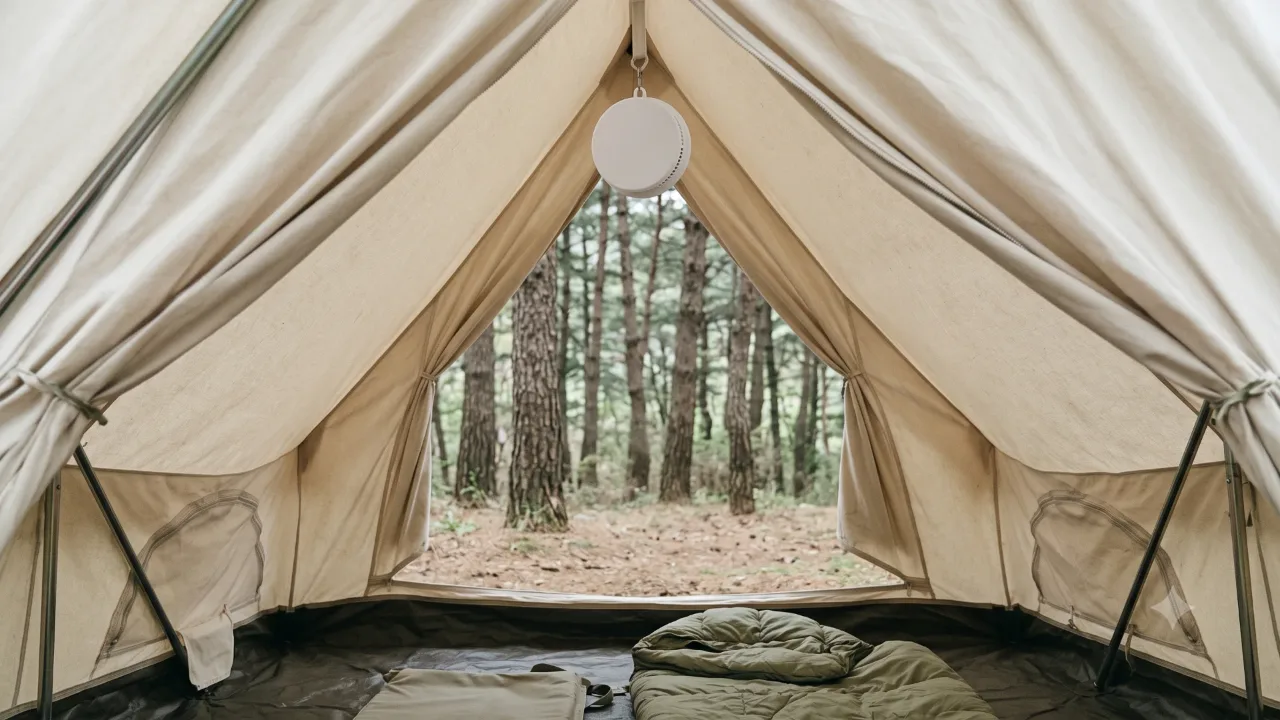
The National Fire Research Institute compared when alarms sounded at different positions inside a tent. The ceiling was fastest and the floor was slowest. Carbon monoxide has less mass per unit volume than oxygen, so it rises on buoyancy, and putting the alarm high in the tent lets you notice the danger sooner.
The experiment also shows why speed matters. A small fire pit loaded with firewood or charcoal briquettes hit 500 ppm, the upper limit of the measurement, in just 45 seconds inside a dome tent. Citing Korea Gas Safety Corporation data, the National Fire Agency added that 400 ppm causes headaches after one to two hours, and 1,600 ppm can lead to death after two hours.
Can you relax once you have an alarm?
No. An alarm is a device built to sound when carbon monoxide reaches a set concentration. In the National Fire Agency experiment, the problem with gas and kerosene heaters was carbon dioxide rather than carbon monoxide.
- Carbon monoxide came out below the permissible airborne level of 50 ppm.
- Carbon dioxide rose as high as 45,000 ppm, or 4.5% of the air.
- Citing US OSHA data, the National Fire Agency explained that at 3% heart rate and blood pressure rise, at 5% dizziness, headaches, and difficulty breathing appear, and at 8% loss of consciousness or death becomes likely.
The National Fire Agency said not to use firewood or charcoal fire pits inside a tent, and that regular ventilation is needed when you have no choice but to use gas or kerosene heaters.
What should you check when buying?
What to look at before buying comes down to four things.
- Check whether the product information lets you verify Korea Fire Institute (KFI) type approval (KC certification).
- Check whether the manual or sales page states the alarm concentrations and times and the volume (dB).
- Check whether the power source is replaceable batteries or a rechargeable battery. According to the Consumer Agency, most products sold for camping use one of these two.
- Decide on a mounting position near the tent ceiling, as in the National Fire Agency experiment.
Even with an alarm, a carbon dioxide problem remains if you use a gas or kerosene heater. Make a ventilation plan separately from the alarm.
Product information
Candidates compared
-
Breezemoon Carbon Monoxide Alarm
-
Bendict Lanyard Carbon Monoxide Alarm Untamed
Check price and stock at the link. Product information is as of the date checked.
Frequently Asked Questions
Where in the tent should I put the alarm so it sounds sooner?
In the National Fire Agency experiment, the alarm responded fastest near the tent ceiling and slowest near the floor. The explanation given is that carbon monoxide rises because of buoyancy.
Which certification should I check?
The Korea Consumer Agency advises choosing a product whose Korea Fire Institute (KFI) type approval, that is, KC certification, can be verified. It also points out that this standard applies to products installed in buildings, and portable products are sold without performance verification.
If I only use gas or kerosene heaters, do I not need to worry about carbon monoxide?
In the National Fire Agency experiment, carbon monoxide from gas and kerosene heaters stayed below the 50 ppm permissible level, but carbon dioxide rose as high as 4.5%. It advises ventilating regularly when you have no choice but to use them.
Sources & Verification Date
- Some camping gas leak alarms fall short on performance (Korea Consumer Agency press release, 2025-03-06) · Verified
- How to enjoy winter camping safely: an experiment on carbon monoxide and carbon dioxide risks inside tents (National Fire Agency press release, 2024-01-17) · Verified
All materials have been verified from official announcements and may have changed since verification.